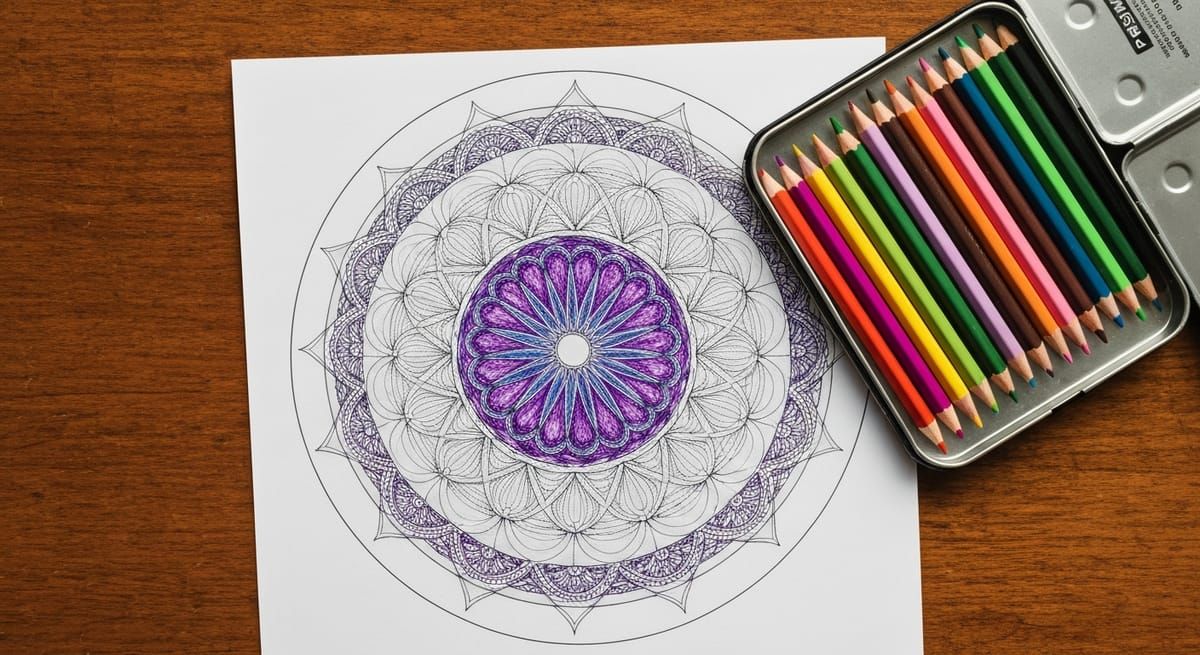
De ultieme gids voor mandala-kleurplaten
Alles wat je moet weten over het inkleuren van mandala's: het kiezen van de moeilijkheidsgraad, kleurplanning, technieken, benodigdheden, veelgemaakte fouten en het opbouwen van een dagelijkse routine.
I avoided mandalas for months. They looked intimidating — all those tiny triangles and repeating wedges crammed into a circle. I figured they were for people with more patience than me.
Then my daughter handed me one she'd printed but didn't want ("too many small parts, Mom"), and I had nothing else to color that evening. An hour later, I looked up from a half-finished mandala and realized I'd completely forgotten about the work email that had been bothering me all day.
I've since colored hundreds of mandalas, and they've become my favorite type of coloring page by a wide margin. Here's everything I've learned about why mandalas work so well and how to get the most out of them.
What makes mandalas different from other coloring pages
A mandala is a circular design with a repeating pattern that radiates outward from a center point. The word comes from Sanskrit and means "circle," though the designs have appeared independently in cultures worldwide for thousands of years — Tibetan Buddhism, Hinduism, Native American traditions, Celtic art.
For coloring purposes, what matters is the structure. Mandalas are symmetrical. The same shapes repeat around the circle, usually in rings. This repetition is what makes them especially effective for relaxation and focus.
When you color a flower or an animal, every section is different. You have to make new decisions constantly: what color for the wing? The eye? The background? Each choice requires mental effort.
With a mandala, you make a color choice once and then repeat it across the pattern. Color one petal blue, and you know the next seven petals are blue too. Your brain can settle into a rhythm instead of constantly problem-solving. That rhythm is what makes mandalas feel almost meditative.
The research behind mandala coloring
Mandalas are also the most studied type of coloring page in anxiety research.
The landmark study by Curry and Kasser (2005) specifically tested mandalas against free-form drawing and plaid patterns. Mandalas and plaid patterns both reduced anxiety significantly. Free-form drawing didn't. The researchers concluded that the structured, repetitive nature of these designs was the key factor.
Van der Vennet and Serice replicated this in 2012, again finding that mandala coloring produced greater anxiety reduction than unstructured coloring. Carsley and Heath (2015) found similar results with university students.
Carl Jung, the psychiatrist, was actually onto this a century ago. He had his patients draw and color mandalas as part of therapy, believing the circular patterns promoted psychological integration and self-awareness. He colored them himself daily for years. Modern research suggests he was right about the calming effect, even if his theoretical framework was different from what we'd use today.
If you're coloring for stress relief or relaxation, mandalas have more research backing than any other design type. Our stress relief coloring guide goes deeper into this research.
How to choose the right mandala
Complexity matters, and the right level depends on your experience and what you're going for.
Simple mandalas (beginners and quick sessions)
These have large sections, thick lines, and fewer repeating elements. Think 8-12 segments with simple shapes: circles, petals, basic geometric forms. You can finish one in 15-30 minutes.
Simple mandalas work best for:
- People new to coloring
- Short coloring sessions (lunch break, waiting room)
- When you're very stressed and need something calming without being demanding
- Kids who want to try mandalas
Medium mandalas (the sweet spot)
Medium-complexity mandalas have more rings, smaller sections, and a mix of simple and detailed areas. They typically have 16-24 segments with varied shapes. Expect 45-90 minutes to complete one.
This is where most adults land after a few sessions. The complexity is high enough to hold your attention without causing frustration. You get into a flow state more easily with medium mandalas than with simple or complex ones.
Complex mandalas (experienced colorists)
Dense, intricate designs with many rings, tiny sections, and elaborate detail. These can take 2-4 hours or span multiple sessions.
Complex mandalas are satisfying when you have the patience for them. The finished result is impressive, and the extended focus time deepens the meditative effect. But they can also be frustrating if you're tired or not in the mood for precision work.
My advice: start with medium. If you find yourself wanting more detail, move up. If medium feels overwhelming, drop to simple. There's no progression requirement. I still color simple mandalas on stressful days when I need something easy and calming.
Browse our mandala coloring pages to find designs at every complexity level.
Color planning: the part most people skip
Random color selection works fine for casual coloring. But if you want your finished mandala to look cohesive and striking, spending two minutes on a color plan makes a huge difference.
The ring method
Pick 3-4 colors. Assign each one to a ring of the mandala. Color each ring consistently. This is the simplest approach and it produces clean, organized results every time.
For example: dark blue for the outermost ring, medium blue for the next, light blue for the third, and white or cream for the center. You get a gradient effect that looks intentional without requiring any artistic talent.
The alternating method
Pick 2-3 colors. Alternate them within each ring. If a ring has 12 petals, color them red-blue-red-blue or red-blue-green-red-blue-green. The repetition creates a satisfying pattern, and limiting yourself to a few colors keeps things harmonious.
The warm-cool split
Divide the mandala in half (mentally or with a light pencil line). Color one half in warm tones (reds, oranges, yellows) and the other in cool tones (blues, greens, purples). This creates a dramatic contrast that makes even simple mandalas look sophisticated.
The monochromatic approach
Use different shades of a single color family. Five or six shades of blue, for instance, from nearly white to nearly black. The result is elegant and surprisingly easy to pull off. This is my go-to for mandalas I want to frame or give as gifts.
Techniques that work especially well on mandalas
If you've read our colored pencil techniques guide or our blending guide, you already know the fundamentals. Here's how to apply them specifically to mandalas.
Layering shines here
Mandalas are perfect for practicing layering because each section is small and self-contained. Apply 2-3 light layers in each petal or segment, building up gradually. The repetition means you'll get better at controlling your layers as you work around the circle. By the time you're halfway around, your technique will have noticeably improved from where you started.
Use the blender pencil strategically
Don't blend every section of a mandala. Blend some and leave others with visible pencil texture. The contrast between smooth blended areas and textured areas adds visual depth. I usually blend the larger sections and leave the smaller detailed parts unblended.
Gradients within sections
For each petal or segment, start darker at the base (near the center) and lighten toward the tip (toward the edge). Even a subtle gradient makes the design look three-dimensional. Use the same color at two pressure levels — heavy at the base, light at the tip — and blend the transition.
Metallic and gel pen accents
After you've finished coloring with pencils, go over select lines or details with a gold or silver gel pen. This adds a finished, almost professional quality. Sakura Gelly Roll metallic pens (about $8 for a set of 10) are perfect for this. Don't overdo it — a few accent lines are more effective than covering everything in metallic.
The best supplies for mandala coloring
Mandalas have lots of small sections, which means you need tools with good precision.
Prismacolor Premier colored pencils (72-pack, about $45) are my top pick. Soft enough for smooth color, sharp enough for tiny sections. If you're on a budget, Prismacolor Scholar (48-pack, about $20) performs well for mandala work too. They're slightly firmer, which can actually be an advantage for the small sections in complex mandalas.
If you prefer bold, saturated color, Tombow Dual Brush Pens (10-pack, about $18) are worth trying. The fine tip handles mandala details well, and the brush tip fills larger sections fast. Print on 32lb paper or cardstock if you use these. They'll bleed through regular copy paper.
You'll also want a good pencil sharpener. Mandalas punish dull points. The small sections require a sharp tip for clean edges. I use a Prismacolor handheld sharpener (about $5) and sharpen every 5-10 minutes while working on detailed mandalas. Sakura Gelly Roll metallic gel pens (about $8) and a colorless blender pencil ($3) are nice additions once you have the basics covered.
Common mistakes with mandala coloring
Starting from the outside. Most people begin at the outer edge and work inward. This means you're doing the largest, most detailed sections when you're freshest and the simpler center sections when you're tired. Start from the center instead. The small center sections warm you up, and by the time you reach the outer rings, your technique is flowing and your color choices feel natural.
Using too many colors. It's tempting to use every pencil in the box. Resist. Three to five colors produce more cohesive results than ten or twelve. You can always add colors on your next mandala.
Pressing too hard. Small sections tempt you to press hard for quick coverage. But heavy pressure fills the paper tooth and makes blending impossible. Light layers in small sections look better and give you more flexibility to adjust.
Rushing the last ring. The outer ring of a mandala is the most visible part of the finished piece. Don't rush it because you're tired. If you need to stop, stop. Come back to it later with fresh focus.
Mandala coloring as a daily practice
If you want to use mandalas specifically for mental health benefits (stress reduction, mindfulness, focus improvement), treating it as a practice rather than a hobby makes a difference.
Fifteen to twenty minutes is enough. You don't need to finish a mandala in one sitting. Working on the same one over several days actually deepens the meditative benefit because returning to a familiar design reduces decision fatigue.
Keep your mandala and supplies set up somewhere accessible. If you have to dig through a drawer to find everything, you'll skip sessions. A small tray on a desk or a basket on the coffee table works. And put your phone in another room or turn it face-down. The mindfulness benefit disappears if you're checking notifications every five minutes.
Some sections will look better than others. Some color choices won't work. That's fine. The benefit comes from the process, not the product. The moment you start judging your work, you've turned a relaxation practice into a performance.
I've been coloring one mandala per week for the past year. Some weeks I skip. Some weeks I color two. The consistency matters more than the intensity, and even a couple of sessions per week produce noticeable effects on my stress levels and sleep quality.
Pages to get started
Our mandala coloring pages collection has designs at every complexity level. Here's where I'd start:
For your first mandala, pick something in the "medium" difficulty range with clear, well-defined sections. Avoid the ones that are so intricate they look like they were designed to test your vision.
If you enjoy flower coloring pages, try a floral mandala — they combine the organic shapes of flowers with the structured repetition of mandala patterns. Good bridge between the two styles.
For a real challenge, look for mandalas that incorporate animal or butterfly motifs into the circular pattern. These mix the repetitive structure of a mandala with the creative variation of figurative designs.
Print on 28-32lb paper for the best coloring experience, especially if you plan to use blending techniques or markers. And keep a few simple mandalas printed and ready for the days when you just need something calming and uncomplicated.
Whatever you pick, give it 20 minutes. I started with a castoff my daughter didn't want. Now I go through one a week. Mandalas have a way of sneaking up on you like that.
Art Educator & Content Director
Art educator with 12+ years of classroom experience. Certified in Art Education and Child Development. Helping families and teachers unlock the power of creative play.
You Might Also Like
Hoe maak je van een foto een kleurplaat (gratis AI-tool)?
Hoe je elke foto kunt omzetten in een printbare kleurplaat met behulp van een gratis AI-tool. Behandelt de beste fototypes, stapsgewijze instructies, creatieve toepassingen en kleurtips voor gepersonaliseerde kleurplaten.
Hoe je bloemen kleurt: tips voor realistische bloemblaadjes, bladeren en boeketten
Alles wat je moet weten over het realistisch inkleuren van bloemen: schaduwtechnieken voor bloemblaadjes, bladtechnieken, lichtinval, kleurenpaletten, veelgemaakte fouten en de beste materialen.
Kleurpotloden mengen: 5 methoden van basis tot gevorderd
Vijf kleurpotloodmengmethodes van eenvoudige lagen tot solventtechnieken. Inclusief aanbevelingen voor benodigdheden, een vergelijkingstabel en een vier weken durend oefenplan.