Ausmalbilder zum Stressabbau: Was die Forschung tatsächlich sagt
Kann Ausmalen tatsächlich Stress abbauen? Ich habe mich mit der Forschung über Ausmalbilder zum Stressabbau befasst und festgestellt, dass die Wissenschaft solider ist als erwartet. Hier erfahren Sie, was funktioniert, was nicht, und wie Sie eine Malpraxis aufbauen können, die tatsächlich hilft.
I never thought of coloring as "self-care." It was something my kids did on rainy afternoons while I tried to answer emails. Then one particularly brutal Tuesday — the kind where you have three deadlines, a leaking dishwasher, and your phone won't stop buzzing — my daughter pushed her half-finished butterfly page toward me and said, "You look like you need this more than me."
I sat down for five minutes. Those five minutes turned into forty. When I looked up, I felt noticeably calmer. Not "spa day" calm, but the tight feeling in my chest had loosened, and my to-do list didn't feel quite so suffocating.
That got me curious. Was this just a pleasant distraction, or is there something real happening when adults color? I started reading the actual research.
The science isn't just hype
I should say upfront: coloring isn't a replacement for therapy or professional help. But the research on coloring and stress reduction is more solid than I expected.
The study that kicked it all off was published in 2005 by psychologists Nancy Curry and Tim Kasser at Knox College. They gave 84 college students an anxiety-inducing task (writing about a time they felt afraid), then split them into three groups: one colored mandalas, one colored plaid patterns, and one drew on blank paper. Both the mandala and plaid groups showed measurable drops in anxiety. The free-drawing group? Barely any change.
That study has been replicated multiple times since. Van der Vennet and Serice ran a similar experiment in 2012 and got the same results — structured coloring reduced anxiety significantly more than unstructured drawing. A 2015 study by Carsley and Heath found that university students who colored structured patterns reported lower anxiety than those who colored free-form designs.
Every one of these studies points to the same thing: the structure matters. Coloring a mandala or a plaid pattern works because there are defined boundaries and repeating shapes to follow. Free-form drawing on a blank page doesn't do the same thing.
Why structured patterns work
When you color a mandala or a detailed pattern, your brain has to do a few things at once: choose colors, stay within lines, plan which section to do next, and coordinate your hand movements. That sounds like it would add stress, not reduce it, right?
Actually, it's the opposite. Some psychologists call this "active meditation." Your mind is busy enough that the anxious thoughts and mental chatter don't have room to run. You're not trying to empty your mind (which, let's be honest, is really hard). Instead, you're filling it with a low-stakes task that requires just enough focus to crowd out the noise.
Dr. Stan Rodski, a neuropsychologist who researched coloring extensively, found that repetitive, detailed coloring activities trigger changes in brain wave patterns. Specifically, they decrease activity in the amygdala (the part of your brain responsible for the fight-or-flight response) and increase activity in the prefrontal cortex (the part that handles planning and focus).
In plain English: coloring tells your panic brain to quiet down while letting your thinking brain take the wheel.
What doesn't work (and what I learned the hard way)
Most articles about "adult coloring for stress" skip over an important detail: not all coloring is equally effective for stress relief. I found this out personally.
After that first experience with my daughter's butterfly page, I bought one of those adult coloring books with incredibly complex designs. Tiny, intricate geometric patterns that covered every inch of the page. I figured more detailed would mean more relaxing.
Wrong. I spent twenty minutes trying to color a section smaller than my thumbnail and ended up more stressed than when I started. My hand cramped, I accidentally went outside a line and couldn't fix it, and the whole thing felt like a test I was failing.
The research backs this up. When patterns are too complex, they create frustration rather than flow. The sweet spot is designs that are detailed enough to hold your attention but not so intricate that they feel punishing.
Here's what works well for stress relief specifically:
Mandalas with medium detail. Mandala coloring pages are the most studied coloring format for anxiety reduction. Look for ones with clear sections and a good mix of large and small areas to fill. Avoid the ultra-fine ones with hundreds of tiny segments.
Nature patterns. Flower coloring pages and butterfly coloring pages hit a nice balance. The organic shapes are forgiving (nobody's going to notice if you color a petal slightly unevenly), and the variety of shapes keeps it interesting without being overwhelming.
Repetitive designs. Pages with repeating elements — rows of similar shapes, tessellating patterns, paisley designs — are particularly good for stress relief because the repetition itself is calming. You get into a rhythm. Color one leaf, color the next leaf, color the next leaf. Your breathing slows down naturally.
How your body actually responds
The stress reduction from coloring goes beyond feeling calmer. Your body actually changes while you color.
A 2016 study published in the journal Art Therapy found that 45 minutes of creative activity (including coloring) significantly lowered cortisol levels in participants regardless of their skill level or previous art experience. Cortisol is the primary stress hormone your body produces when you're anxious or under pressure. Lower cortisol means your body is literally less stressed, not just your mind.
There's also an effect on heart rate variability. When you're stressed, your heart rate becomes more rigid and less variable (counterintuitively, lower variability is worse). Relaxation activities increase variability, which is a sign your nervous system is switching from "fight or flight" mode to "rest and digest" mode. In one study, participants showed improved heart rate variability after just 20 minutes of coloring.
You don't need a cortisol test to notice this, though. Pay attention next time you sit down to color. After about 10-15 minutes, you'll probably notice your shoulders dropping and your jaw unclenching. Your breathing slows down on its own. Those are physical signs that your stress response is winding down.
Building a coloring practice for stress relief
If you want to use coloring specifically for stress management and not just as a casual hobby, a few things make it work better:
Pick the right time
Don't wait until you're already having a panic attack. Coloring works best as a preventive practice, kind of like exercise. Some people color for 15-20 minutes in the morning before their day gets hectic. Others use it as an after-work decompression ritual. I do it right after putting the kids to bed, when the house is finally quiet and my brain is still buzzing from the day.
Set up a dedicated space
This sounds fussy, but it matters. Having your supplies ready and a comfortable spot to color removes the friction of getting started. If you have to dig through a drawer for pencils every time, you'll stop doing it. I keep a small basket on the kitchen table with my coloring pages, a set of pencils, and a sharpener. The basket is the signal: sit down, color, decompress.
20 minutes is the sweet spot
Most of the studies showing stress reduction benefits used sessions of 20-45 minutes. Shorter than 15 minutes doesn't seem to produce consistent results. You need enough time to transition out of your stressed mental state and into the flow of coloring.
That said, something is better than nothing. Even 10 minutes is worth doing. Just don't expect the same deep relaxation you'd get from a longer session.
Use simple supplies
Fancy supplies are fun, but they can add decision fatigue when you're trying to relax. For stress relief specifically, I'd recommend:
Prismacolor Scholar colored pencils (48-pack, about $20). Soft enough to be satisfying, affordable enough that you won't stress about using them up. This is the set I keep in my kitchen basket.
Crayola Super Tips markers (50-pack, about $12). If you prefer markers over pencils, these are smooth, cover evenly, and the broad tips mean you can fill large areas quickly without hand fatigue.
A good quality paper. Print your coloring pages on 32lb cardstock or heavier printer paper. Thin paper buckles under markers and doesn't hold pencil pigment well, which creates frustration. Spending an extra few cents per page on better paper makes a real difference in the experience.
Don't try to make it perfect
This is the hardest rule for stressed-out, perfectionist adults (and I'm speaking directly to myself here). You're not trying to create something beautiful. You're trying to give your brain something to do that isn't worrying.
Color outside the lines. Use "wrong" colors. Leave sections unfinished. None of that matters. The stress-relieving benefit comes from the process, not the product. The moment you start judging your work, you've turned a relaxation activity into a performance and the stress comes right back.
The best types of coloring pages for stress relief
Some coloring pages are better for stress relief than others. After reading the research and going through a fair amount of personal trial and error, here's what I'd recommend:
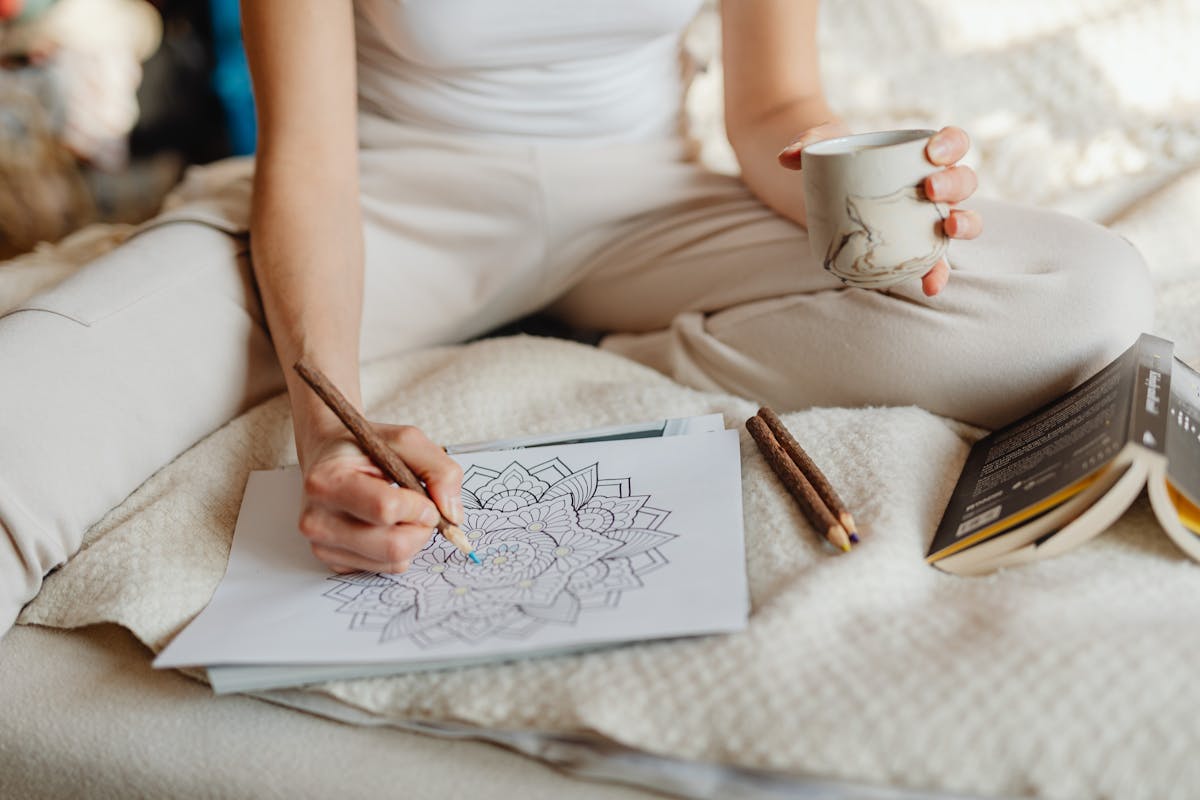
Mandala coloring pages are the most research-backed option. The circular, symmetrical designs naturally draw your focus inward. There's a reason mandalas have been used in meditation practices for centuries. Pick ones with medium complexity, enough detail to stay engaged, not so much that you need a magnifying glass.
Flower coloring pages and butterfly coloring pages are great if you prefer organic shapes. There's no "wrong" way to color a rose, and a purple one is just as valid as a red one. The variety of petal shapes keeps things interesting across multiple sessions without the precision pressure of geometric patterns.
For longer sessions where you want to get really absorbed, cat coloring pages, owl coloring pages, and fish coloring pages have a good mix of large areas (body) and detailed areas (fur, feathers, scales). You can switch between mindless filling and focused detail work, which keeps you in that flow state longer.
And when you only have 10-15 minutes, go simple. Heart coloring pages and rainbow coloring pages let you make real progress in a short sitting. There's something satisfying about finishing a section, even a small one.
What about coloring apps?
I get this question a lot. Digital coloring apps are convenient, and some of them are well-designed. But the research leans pretty heavily toward physical coloring being more effective for stress reduction.
Screens are part of the problem. The blue light, the notifications lurking one swipe away, the temptation to check another app. All of it undercuts the calming effect. And the tactile experience of pencil on paper seems to matter too. There's something about the physical sensation of coloring, the way the pencil catches on the paper grain, that tapping a screen just doesn't replicate.
Flett and colleagues published a study in 2017 comparing digital and paper-based coloring for stress relief. Both reduced negative mood, but paper coloring was more effective at reducing anxiety specifically.
If digital coloring is your only option (traveling, no supplies handy), it's still better than doomscrolling. But when you have the choice, paper and pencils win.
My personal coloring-for-calm routine
I've been doing this for about a year now, and here's the routine that actually stuck:
Evening wind-down (most nights, 20-30 minutes):
- Kids in bed. Phone plugged in across the room (not next to me).
- Make tea. Something without caffeine — chamomile or peppermint.
- Sit at the kitchen table. Pull out the coloring basket.
- Pick a page. I usually have 2-3 in rotation. Tonight, I'm working through a mandala that I've been adding to all week.
- Color. No goals, no plan. Just pick a section and a color and go.
- When the tea is done or I feel my eyelids getting heavy, I stop. Sometimes that's 15 minutes, sometimes it's 45.
Rough day rescue (as needed, 10-15 minutes): When I'm having a bad day and need a quick reset, I grab a simpler page — usually a flower or butterfly design — and color for 10 minutes. I specifically focus on the physical sensations: the texture of the paper, the waxy glide of the pencil, the sound of coloring. It's basically a grounding technique, but more fun than the ones therapists teach you.
The part that surprised me most
The thing I didn't expect was the cumulative effect. A single coloring session makes a noticeable dent in my stress level. But after doing it regularly for a few months, I noticed changes that went beyond those individual sessions. I fall asleep faster. I'm less reactive when small things go wrong during the day. I have a general sense of being a little more anchored.
Is that just the coloring? Maybe not entirely. Probably the tea helps, and putting my phone away definitely helps, and having a consistent evening routine of any kind would probably have benefits. But coloring is the anchor that makes the whole routine stick because it's genuinely enjoyable. I've tried journaling, meditation apps, stretching routines. They all felt like homework. Coloring feels like a break.
The research on cumulative benefits is thin compared to the single-session studies. Mantzios and Giannou ran a small study in 2018 where participants who colored mandalas regularly for a week showed sustained improvements in mindfulness scores. But honestly, we need more long-term research before anyone can say anything definitive.
What I can say from experience is that it's helped me. It costs almost nothing and the worst-case scenario is you end up with some pretty pictures on your fridge. Hard to argue with that.
Getting started
If you want to try this, here's the minimum you need:
- Print 3-5 coloring pages. Start with mandala coloring pages since they have the strongest research backing for stress relief. Use 32lb paper if you can.
- Get a basic set of colored pencils. A 24-pack of anything will do. Even a kid's set from the dollar store works. You can upgrade later if you stick with it.
- Set a timer for 20 minutes. Put your phone face-down or in another room. Just color until the timer goes off.
- Do it three times this week. That's enough to know if it works for you.
That's it. No special training, no app subscription. Just you, some pencils, and a page of patterns. The research says it works. My own experience says the same. Try it for a week and see what you think.
Art Educator & Content Director
Art educator with 12+ years of classroom experience. Certified in Art Education and Child Development. Helping families and teachers unlock the power of creative play.