Disegni di animali da colorare per bambini: una guida per i genitori sull'apprendimento attraverso il colorare.
Una guida per i genitori sull'utilizzo dei disegni di animali da colorare a scopo educativo. Disegni adatti a tutte le età, dai più piccoli ai preadolescenti, attività didattiche, consigli sui materiali necessari e gli animali più richiesti.
My five-year-old went through a phase where she insisted every animal was either "a cat or a dog." Cow? Big dog. Horse? Really big dog. Penguin? Weird cat. We were at the zoo, and I realized she didn't actually know what most animals looked like up close, because she'd only ever seen them on a screen, moving too fast to study.
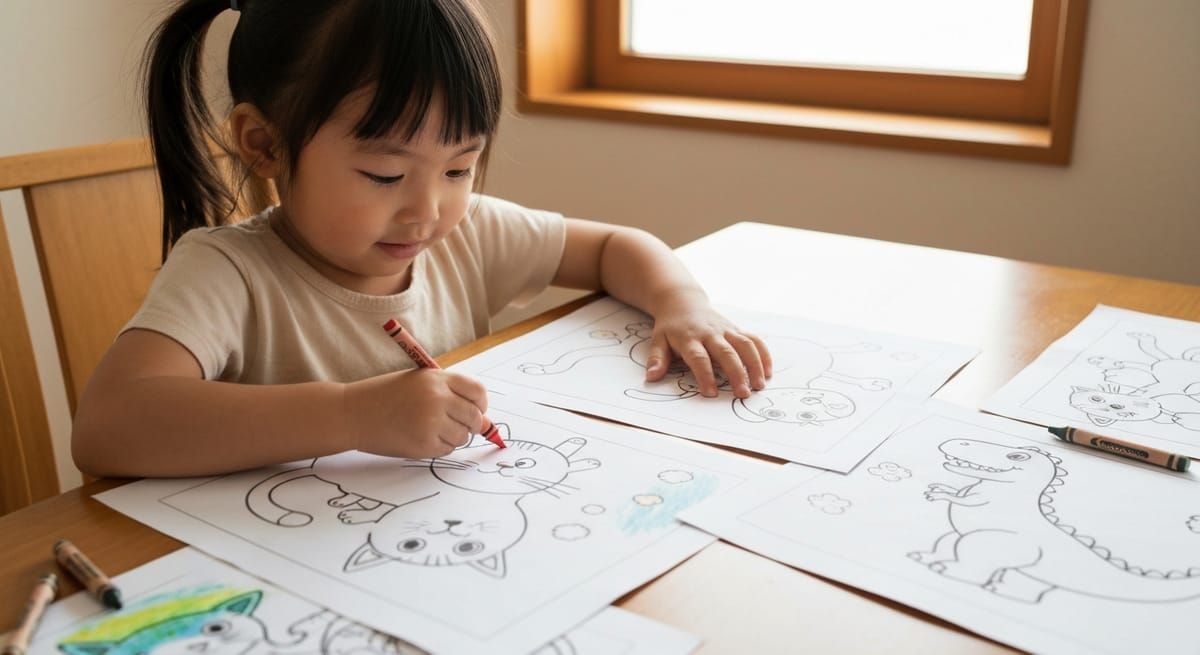
That week I printed a stack of animal coloring pages. She sat at the kitchen table for over an hour with a fistful of crayons, asking me questions about every single one. "Do frogs really have that many toes?" "Why is the elephant's skin all wrinkly?" "Can dolphins actually jump that high?" She learned more about animals in one afternoon of coloring than she had in months of nature documentaries playing in the background.
That was two years ago. Animal coloring pages are now a permanent fixture in our house, and I've picked up a few things about which ones work best for different ages, how to sneak in some actual learning, and which animals kids gravitate toward (spoiler: dinosaurs always win).
Why animal pages work so well for kids
Kids are drawn to animals. That's not a groundbreaking observation, but it matters when you're picking coloring pages. A kid who won't sit still for a geometric pattern will spend forty minutes coloring a shark because sharks are cool and they want to get the teeth right.
Animal pages also give you a natural opening for conversation. When your kid is coloring a turtle, you can mention that some sea turtles live to be over 100 years old. When they're working on a lion, you can talk about why male lions have manes. The coloring keeps their hands busy, so they're more willing to listen.
If you want to read more about the developmental side of coloring for kids, we have a whole article on why coloring is good for kids. I won't rehash all of that here, but the short version: fine motor skills, focus, and patience.
Picking the right animals for each age
This is where most parents (including me, at first) get it wrong. You hand a toddler a detailed wolf page with fur texture and shading, and they scribble on it for thirty seconds before moving on. You give a ten-year-old a page with one big circle-bodied cat, and they feel insulted.
Get the difficulty right and your kid actually finishes the page. That feels good, so they want to do another one.
Toddlers (ages 2-4): farm animals and pets
Start simple. Really simple. Thick outlines, big shapes, minimal detail. A round-bodied cat with a big head. A chunky dog with floppy ears. A cow that's basically an oval with spots.
Farm animals work well at this age because toddlers can connect them to sounds. "What does the cow say?" is a game that never gets old at two years old, and coloring a cow while mooing is about as entertaining as it gets for a two-year-old.
Good picks for this age: cats, dogs, ducks, pigs, cows, chickens. Stick to animals they've seen in person or in their favorite board books.
Preschool (ages 4-6): pets, bugs, and pond animals
By four or five, kids can handle more detail. They're starting to care about coloring inside the lines (or at least attempting it), and they want animals with personality. This is the age where a frog with big googly eyes or a butterfly with patterned wings gets them excited.
Fish coloring pages are great at this age too, because kids can go wild with color choices. Nobody knows what color a made-up fish should be, so there's no "wrong" answer. Purple fish with orange stripes? Perfect.
Bugs and insects also land well with preschoolers. Ladybugs, caterpillars, bees. Simple enough to color, interesting enough to talk about.
Early school-age (ages 6-8): wildlife and ocean creatures
Now you can get into the good stuff: dolphins leaping out of the water, elephants with wrinkly skin, owls on nighttime branches, penguins huddled on ice.
Kids at this age are learning about habitats in school, so coloring an animal in its environment reinforces what they're picking up in the classroom. Think ocean scenes with dolphins, savannas with elephants, or forests with owls and deer.
This is also the age where kids start to care about realism. They'll want to know if they're coloring the animal the "right" color. Keep a tablet or book nearby so they can look up what the animal actually looks like. Watching a six-year-old carefully mix brown and grey to get the exact right shade for an elephant is pretty endearing.
Older kids (ages 9-12): detailed and realistic pages
By nine or ten, many kids want pages that actually challenge them. They want detailed horse pages with flowing manes, realistic bird pages where every feather is distinct, or complex ocean scenes with coral reefs.
Dinosaur coloring pages have a permanent fan base in this age group. Kids love the scale detail and the drama of a T-Rex mid-roar, plus the satisfaction of coloring a Triceratops with historically-debated accuracy. (Yes, my nine-year-old has opinions about dinosaur colors based on "the latest research." I don't argue.)
Using animal pages for actual learning
Coloring pages are quiet, which is reason enough to use them. But animal pages also make it easy to squeeze in some education.
The habitat game
Before your kid starts coloring, ask: "Where does this animal live?" Then let them color the background to match. A dolphin gets a blue ocean. A lion gets golden savanna grass. A frog gets a green pond with lily pads.
This seems basic, but it sticks. My daughter can tell you that penguins live in Antarctica and that elephants live in both Africa and Asia, and I'm pretty sure she learned both of those facts while coloring.
The diet conversation
"What do you think this animal eats?" is a reliable conversation starter while your kid is coloring. You'd be surprised how much kids enjoy learning that owls eat mice whole and cough up the bones later. It's gross, but kids never forget it.
Some animals lead to interesting food chain discussions. The shark eats the fish, the fish eats smaller fish, the small fish eats plankton. You can sketch a quick food chain on the back of a coloring page and connect it to what they're working on.
Fun fact cards
I started writing one fun fact on the back of each coloring page before I print it for my kids. Just one sentence.
- "Elephants can recognize themselves in a mirror."
- "Dolphins sleep with one eye open."
- "Octopuses have three hearts."
- "Rabbits can't vomit."
That last one gets quoted at the dinner table more than I'd like, but they remember every single fact. Something about reading it right before coloring the animal makes it stick.
Realistic vs. cartoon: when each works best
Cartoon-style animal pages (big eyes, round bodies, smiling faces) are best for younger kids and for fun. They're approachable and forgiving, because the animal already looks silly, so "wrong" colors don't matter.
Realistic-style pages work better for learning and for older kids. When a horse actually looks like a horse, kids pay attention to the anatomy. They notice the legs, the mane, the proportions. They start to see the real animal in the drawing.
We have both styles across our topic pages. If you're not sure which to pick, realistic pages tend to hold older kids' attention longer, and cartoon pages keep younger kids from getting frustrated.
Supplies that make animal coloring better
You can absolutely do this with whatever crayons are at the bottom of your kid's backpack. But a few small upgrades make a difference.
For everyday coloring, Crayola crayons (64-pack, about $6) cover every animal color you'd need, and the built-in sharpener helps with details like eyes and whiskers. If your kid wants more realism, colored pencils (50-pack, about $9) let them blend and layer, which matters when they're going for realistic fur or feathers. We have a whole guide on how to color with colored pencils if they want to level up. For toddlers, washable markers (Crayola SuperTips 50-pack, about $12) are bright, dry fast, and come out of most clothes.
If you're not sure which coloring tool to pick, our comparison of crayons, colored pencils, and markers breaks down the pros and cons for different ages.
Paper tip: Print on 28lb or 32lb paper if you're using markers. Standard copy paper lets marker ink bleed through to the table (and I've learned this the hard way on more than one placemat).
Animals kids ask for the most
Based on what gets printed the most in our house, and what I hear from other parents:
- Dinosaurs. Always. Dinosaur pages are requested more than everything else combined in the 6-10 age range.
- Cats and dogs. Especially for kids who have pets. My daughter draws a collar on every cat coloring page and names it after our cat.
- Sharks and dolphins. Ocean animals are a big hit, especially after a trip to the aquarium or watching a nature show.
- Horses. There's a certain type of kid (you know the one) who will color nothing but horse pages for three months straight.
- Butterflies. Kids love that a butterfly can be any color combination, so there's no wrong answer.
Making it a regular thing
The most effective way I've found to use animal coloring pages: keep a folder of printed pages on the counter. Not in a drawer or a craft bin, but right on the counter, next to a cup of crayons.
When my kids are bored, restless, or need to wind down before bed, they grab a page. No setup, no screen negotiation. It's just there.
I refresh the folder once a week or so. I'll print ocean animals one week and birds the next. Rotating the themes keeps it fresh and gives me a chance to tie in whatever they're learning at school.
Follow your kid's current obsession
If your kid is into a specific animal right now, that's your starting point. Print five or six pages of that animal in different styles and difficulty levels. Once they're done, introduce a related animal. Cat lover? Try a lion. Dog fan? Try a wolf. Dinosaur obsessed? Try a bird and tell them birds are actually living dinosaurs. (My kid talked about that for days.)
We've got free printable pages for all of these animals, sorted by difficulty. Pick an animal your kid is into right now, print three pages, and put them on the kitchen table with some crayons tonight. In our house, that usually means twenty minutes of quiet and at least one weird animal fact at breakfast.
Art Educator & Content Director
Art educator with 12+ years of classroom experience. Certified in Art Education and Child Development. Helping families and teachers unlock the power of creative play.
You Might Also Like
Principessa, sirena o unicorno? Una guida ai disegni fantasy da colorare per bambini.
Una guida per genitori alle pagine da colorare fantasy: abiti da principessa, squame di sirena, criniere arcobaleno di unicorno, draghi e fate. Include attività creative, consigli sui materiali e suggerimenti per raccontare storie.
Perché colorare fa bene ai bambini (e non solo perché li fa stare tranquilli)
Il tempo trascorso in silenzio a colorare fa più bene a vostro figlio di quanto pensiate. Ecco cosa dicono le ricerche sulle capacità motorie, la concentrazione e lo sviluppo emotivo.