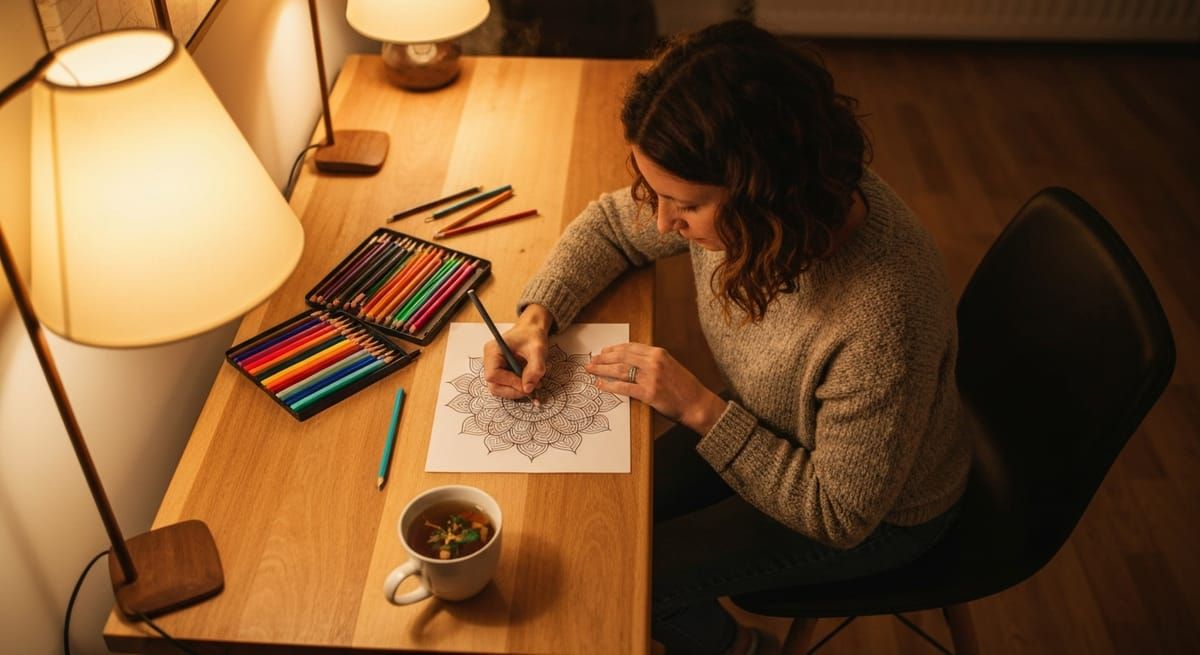
Les bienfaits du coloriage pour les adultes : que se passe-t-il dans votre cerveau lorsque vous prenez un crayon ?
Les bienfaits cognitifs et émotionnels du coloriage pour adultes, étayés par la recherche. Ce livre aborde la réduction du stress, la concentration, la motricité, le sommeil, la pleine conscience, les liens sociaux et la gestion des émotions.
I'll be honest: when I first heard about "adult coloring" as a trend, I thought it was one of those things that would disappear in six months, like fidget spinners or the ice bucket challenge. That was 2015. It's now 2026, and I color most evenings after my kids go to bed.
The reason it stuck isn't because it's trendy. It's because it does things for your brain that most other downtime activities don't. And unlike a lot of wellness trends, there's actual research behind it.
Your brain on coloring
When you color, your brain does something unusual: it activates multiple regions at the same time without overtaxing any of them.
The occipital lobes handle the color and shape perception. The frontal lobes manage the fine motor coordination and decision-making (which color goes where, how much pressure to apply). And because you're doing something repetitive and structured, the amygdala — the part of your brain that generates anxiety and fear responses — quiets down.
Dr. Stan Rodski, a neuropsychologist who spent years researching the effects of coloring on the brain, found that coloring geometric patterns produced measurable changes in brain wave activity. Specifically, he observed increased alpha wave activity, which is the pattern associated with relaxed, calm alertness. It's the same state that experienced meditators reach, just through a different path.
The kicker: you don't need to be good at it. The cognitive benefits kick in regardless of artistic ability. You're not being evaluated. There's no performance pressure. You just pick colors and fill in shapes.
Stress reduction (the one everyone talks about)
This is the most studied benefit, so I'll keep it brief since we covered it in depth in our coloring for stress relief article.
The short version: structured coloring (think mandalas, patterns, detailed designs) reduces cortisol levels and self-reported anxiety in adults. Multiple studies confirm this, including Curry and Kasser's 2005 study at Knox College and a 2020 meta-analysis in the Journal of the American Art Therapy Association.
What's worth adding here is that the stress benefit is cumulative. A 2018 study by Mantzios and Giannou found that people who colored regularly for a week showed sustained improvements in mindfulness scores, not just temporary relief during the coloring session itself. It compounds.
If you want to try this specifically, mandala coloring pages have the strongest research backing.
Focus and concentration
I expected coloring to be purely relaxing, more like zoning out than tuning in. But it turns out coloring requires sustained attention in a way that's actually good for your focus muscles.
Think about what coloring demands: you choose a color, apply it within boundaries, monitor your pressure, decide when to switch to the next section, keep track of your color scheme. Each of these is a small cognitive task, and stringing them together for 20 or 30 minutes is genuine concentration practice.
I noticed this personally before I found the research to back it up. On evenings when I colored before working on something mentally demanding (writing, planning, budgeting), I was noticeably more focused than on evenings when I just scrolled my phone or watched TV. It's like coloring warms up the concentration circuits.
A 2017 study published in Creativity Research Journal found that participants who engaged in creative activities like coloring performed better on subsequent problem-solving tasks. The researchers suggested that the relaxed focus state induced by coloring made it easier to think clearly afterward.
Fine motor skills and coordination
Adults don't talk about fine motor skills much, since it's usually something we associate with kids learning to write. But fine motor skills degrade with age and disuse, and coloring is one of the simplest ways to maintain them.
Occupational therapists have been recommending coloring to adult patients for years, particularly for people recovering from strokes, managing arthritis, or dealing with conditions that affect hand dexterity. The controlled, precise movements required to color within lines work the same small muscles and neural pathways that handle writing, buttoning shirts, and using tools.
Even if you don't have a medical reason to work on hand coordination, you might notice that regular coloring makes your handwriting neater and your hands steadier. I did, after about a month of coloring most evenings.
Improved sleep
Most adults spend the hour before bed looking at screens: phones, tablets, TVs. The blue light from screens suppresses melatonin production, which makes it harder to fall asleep. Replacing 20-30 minutes of screen time with coloring eliminates the blue light problem and replaces a stimulating activity with a calming one.
But there's more to it than just avoiding screens. The relaxation effect of coloring (lowered cortisol, reduced amygdala activity, increased alpha waves) creates physical conditions that help you fall asleep. Your body is calmer, your mind is quieter, and you haven't just exposed your eyes to light that tells your brain it's daytime.
I sleep noticeably better on nights when I color before bed. That's anecdotal, but I've heard the same from dozens of people who color regularly. A 2020 study from the University of Otago found that creative activities before bed (including coloring) improved sleep quality in adults reporting work-related stress.
Mindfulness without meditation
Here's where coloring has a real advantage over other relaxation practices: it doesn't ask you to empty your mind.
Meditation is great. I've tried it many times. I've also failed at it many times, because sitting still and trying to think about nothing makes me think about everything. My brain doesn't want to be empty. It wants to be busy.
Coloring gives it something to be busy with. You're present, you're focused on what's in front of you, and the repetitive motion anchors you in the current moment. That's mindfulness. You're just arriving at it through action instead of stillness.
Art therapist Cathy Malchiodi has written extensively about this, calling coloring a form of "active mindfulness." The feel of pencil on paper and the visual feedback of color filling a space keep you grounded in the present without requiring you to wrestle your thoughts into submission.
This is why coloring works for people who've tried meditation and bounced off it. Same destination, different vehicle.
Social connection
I didn't expect coloring to be social. It seems like a solitary activity, and it can be. But it's also surprisingly social.
Coloring groups have popped up everywhere: libraries, community centers, senior centers, even bars. There's something about sitting together with a shared activity that makes conversation flow more naturally. You're not staring at each other across a table, so there's less social pressure. Your hands are busy, so there are natural pauses in conversation that don't feel awkward.
I joined a monthly coloring group at my local library mostly out of curiosity. I've now been going for eight months. The conversations I have while coloring are different from the ones I have anywhere else — slower, more honest, less performative. There's something about the low-key, non-competitive nature of the activity that makes people relax socially as well as individually.
For people who struggle with social anxiety, coloring groups can be a lower-pressure way to spend time with others. You have a built-in reason to be there and something to do with your hands if conversation stalls.
Emotional processing
The research here is thinner, but the experience is unmistakable.
Coloring gives you a nonverbal way to process feelings. Color choice, pressure, speed — these all shift based on your emotional state, often without you noticing. Therapists who use coloring as part of treatment describe it as a way for patients to express and process emotions that they can't or won't put into words.
You don't need a therapist to experience this. Pay attention to your coloring on a stressful day versus a calm one. On bad days, I tend to use darker colors and press harder. On good days, I reach for brighter shades and work more slowly. The coloring doesn't fix the bad day, but it gives me a channel for the tension that's less destructive than snapping at my family or doom-scrolling Twitter.
What to color for maximum benefit
Not all coloring pages work equally well for these benefits. Based on the research and my own experience:
Mandala coloring pages are the best all-rounders. The symmetrical, geometric patterns activate the most relaxation response in studies, and the repetitive shapes make it easy to enter a flow state.
Flower coloring pages and butterfly coloring pages are great for emotional processing. The organic shapes are less rigid than geometric patterns, which seems to encourage a more free-flowing, intuitive approach to color choice.
For focus training, detailed pages work best — dragon coloring pages and mermaid coloring pages have enough complexity to demand sustained attention without becoming frustrating.
For sleep improvement, stick with medium-complexity pages. You want something engaging enough to hold your attention for 20 minutes but not so challenging that it's stimulating. Simple cat coloring pages or fish coloring pages hit this sweet spot.
Supplies that make it better
You can get all of these benefits with a $3 box of crayons. But if you want the experience to feel a little more special:
Prismacolor Scholar colored pencils (48-pack, about $20) are my go-to recommendation. They're smooth, blend well, and feel satisfying to use. The tactile quality of good pencils actually matters for the mindfulness benefit — the better the pencil feels in your hand, the more present you are while using it.
For something affordable, Crayola Colored Pencils (50-pack, about $8) work fine. For a splurge, Prismacolor Premier (72-pack, about $45) feel incredible.
Print on 28-32lb paper for the best experience. The paper quality affects how the pencils feel, which affects how absorbed you get, which affects the benefits. It's a small investment that makes a real difference.
Check out our complete guide to coloring supplies for detailed recommendations.
The honest truth about coloring as an adult
Coloring isn't therapy. It's not a cure for depression, anxiety, or insomnia. If you're dealing with serious mental health issues, please talk to a professional.
What coloring is: a cheap, accessible, low-risk activity that has genuine cognitive and emotional benefits backed by a growing body of research. It reduces stress, improves focus, maintains motor skills, supports better sleep, and provides a form of mindfulness that doesn't require you to sit still and think about nothing.
And it's fun. Which matters more than it should in a world of "wellness routines" that feel like obligations.
Print a few pages from our free library, grab whatever pencils are nearby, and give it 20 minutes tonight. Worst case, you wasted less time than you would have on your phone.
Art Educator & Content Director
Art educator with 12+ years of classroom experience. Certified in Art Education and Child Development. Helping families and teachers unlock the power of creative play.